Which Washing Machine Fits a Bangladeshi Home?
Washing a family's clothes by hand eats up hours every week, and in humid weather
the drying drags on even longer. A machine takes most of that work off the household.
Choosing one is the hard part, though. The market has several types, sizes, and price
levels, and a wrong pick is expensive to undo.
Start With the Type of Machine
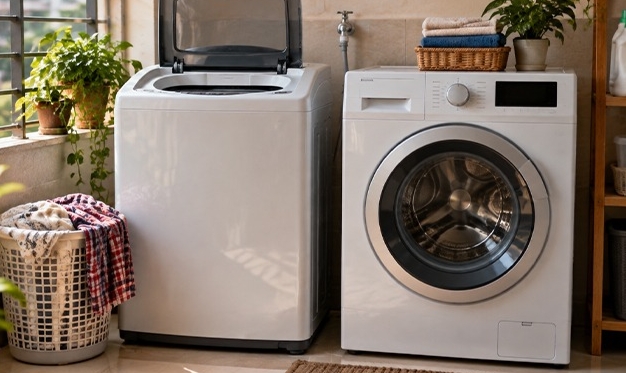
Most machines sold here fall into three types. A twin-tub has one tub for washing and
another for spinning, and the person doing the laundry carries the wet clothes across. It
is the cheapest and the most tiring. Fully automatic top-loaders run the whole cycle
unaided, usually with shorter cycles and a lower price than front-loaders. Fully
automatic front-loaders open at the front, go easier on fabric and use less water, but
they cost more.
A fourth group, the washer-dryers, wash and dry in one drum. They sit at the top of the
price range and make sense for homes with little space to hang clothes.
Match the Capacity to Your Household
A rough guide: 6 to 7 kg for a couple or a family of three, 8 to 9 kg for four or five
people, 10 kg and above for bigger households or anyone who often washes bedding
and curtains. Go too big, and the drum runs half-empty most days; a machine that is too
small means extra loads every week.
What Different Types Cost
Prices depend mostly on brand and capacity, then on features, though current online
listings give a fair picture. An 8 kg twin-tub is listed at around Tk 14,000. A 7 kg fully
automatic top-loader comes in at around Tk 18,000 and a 6 kg front-loader at around Tk
32,000. Larger and inverter models cost more, and an 11 kg wash-and-dry machine is
listed at around Tk 58,000. Prices also move with the seller and the stock.
Buyers who want to line up models and prices from different sellers can browse
https://www.bdstall.com/washing-machine/
Check the Space, Power and Service
Measure the spot and the doorway before ordering. Where the washing area is a corner
of a balcony or a bathroom, a few centimetres decide whether a machine fits. Make
sure a water inlet, a drain and a socket are within reach.
Voltage swings and power cuts are part of life in many areas. A stabilizer or surge
protector shields the control board, and it is worth asking whether the machine picks up
its cycle again after a cut. Ask, too, about the warranty, the nearest service centre and
the price of spare parts. A machine nobody in town can repair is a poor bargain at any
price.
Looking After the Machine Do not overload the drum. Use only as much detergent as the load needs, and rub
heavy stains by hand first. When the wash is done, leave the door or lid open for a while
so the drum can dry, because a closed, damp drum is where bad smells begin. Where
voltage is unstable, switching the machine off at the socket after use is a sensible habit.
None of this takes long, and all of it is easier before the delivery van arrives than after.











0 Comments