Enter without permission"—Why the Hajiganj UNO’s door is open to all
Md. Mohiuddin Al Azad Chandpur Correspondent:
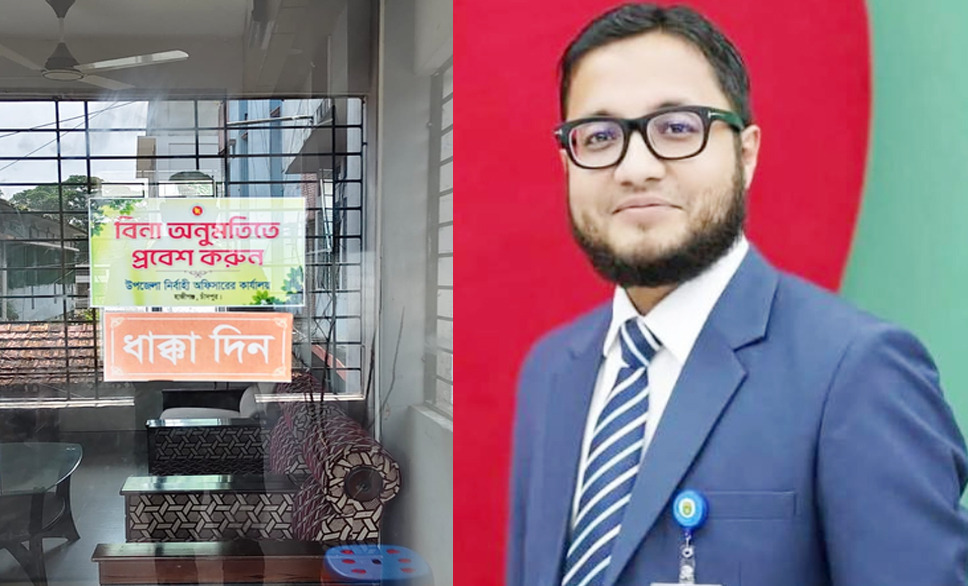
One need not look far to find the answer to how accessible government offices truly are to the general public. Standing before the office door of the Upazila Nirbahi Officer (UNO) of Hajiganj, Chandpur, one immediately notices an unusual instruction: "Enter without permission." Below it, another instruction reads: "Push."
In a context where entering a government official's room usually requires permission—and often involves a long wait—such a message on a UNO's door inevitably draws special attention. Yet, the mindset behind these words is even more significant: ensuring that service seekers do not hesitate to approach the official out of fear or apprehension.
A conversation with Hajiganj UNO Md. Ibne Al Zayed Hossain revealed that this was not a publicity stunt. Rather, the initiative stemmed from an issue faced by ordinary people visiting his office.
"Many do not enter the office out of fear"
Why the sign reading "Enter without permission"?
Responding to this question, UNO Md. Ibne Al Zayed Hossain said, "Many people come to my office but hesitate to step inside due to fear. That is why I put up the 'Enter without permission' sign on the entrance door."
The statement is brief, yet its significance is profound. It reflects the idea that an ordinary citizen seeking government services should never feel helpless or unwelcome.
According to officials in the Upazila administration, people from various areas visit him daily with diverse issues—ranging from land disputes and complications in accessing administrative services to personal grievances. He listens to them and attempts to resolve their problems through the relevant departments.
This approach has earned the UNO a reputation among a section of locals as a "people-friendly official."
Not just an open door—active in the field too
However, evaluating Ibne Al Zayed Hossain’s administrative work solely based on the words written on his office door would be incomplete. Persistent traffic congestion in Hajiganj Bazar was one of the major challenges facing him. In this bustling market, the encroachment of footpaths, roadside shops, hawkers, and the unregulated presence of auto-rickshaws and other vehicles combined to make traffic jams a daily ordeal.
In March 2025, the Upazila administration launched a drive to clear encroached footpaths and roads while implementing measures to control traffic. Local media reported that while the situation improved visibly when officials were present during these drives, the old scenario would often return once they left.
In other words, the problem could not be solved merely through sporadic drives; it required continuous monitoring and the involvement of local stakeholders.
The administration's approach has gradually evolved to address this. Consultations were held with traders, hawkers, political figures, and civil society members to alleviate traffic congestion in the market. Initiatives were taken to make several decisions, including designating specific locations for buses to stop and for passengers to board or alight.
Reports of eviction drives and mobile court operations in the market continued into 2026. During a drive in June to keep footpaths and roads free from encroachment, goods were confiscated alongside the imposition of fines. The Upazila Nirbahi Officer (UNO) stated at the time that such activities would continue to ensure unobstructed pedestrian movement and reduce traffic congestion.
One thing is clear: the focus is shifting from one-off drives to sustained administrative action to resolve long-standing issues like the traffic congestion in Hajiganj Bazar.
A problem with no easy ‘permanent solution’
It cannot yet be claimed that the challenge of keeping Hajiganj Bazar free from traffic congestion has been fully resolved. A recent local report indicates that even after evicting hawkers and removing illegal stands, the question of maintaining a permanently congestion-free market remains. The same report highlights the need for regular mobile court operations.
This is where the true test of an administrative official lies. Conducting eviction drives is relatively easy; the real difficulty lies in ensuring that the encroachments do not return after the eviction.
Ibn Al-Zayed Hossain’s actions demonstrate an effort to maintain that continuity.
An administrative test during elections as well
Recently, the election for the Hajiganj Bazar Traders' Association also generated significant interest. Despite the various discussions and debates surrounding the election, the results were ultimately announced by the Upazila Nirbahi Officer (UNO), Ibne Al Zayed Hossain, along with the relevant election officials.
For a UNO, such an election is not merely an administrative duty; it is a test of maintaining impartiality amidst the conflicting interests, expectations, and differing views of various local stakeholders.
In this context, the public holds a single expectation regarding the administration's role: that no one should perceive the administration as acting in favor of any particular party.
**Action Against Drugs, Juvenile Gangs, and Eve-teasing**
The Upazila administration continues its efforts to keep Hajiganj free from drugs, juvenile gangs, and eve-teasing. Alongside law enforcement, these initiatives emphasize the importance of raising social awareness and building local-level resistance.
The administration's role extends beyond merely punishing offenders; it is also responsible for controlling the conditions that foster a criminal environment. Locals believe that a regular presence in the field is crucial in this regard.
**To what extent can a UNO act like an ‘elected representative’?**
A UNO is not an elected representative, nor are their duties identical to those of an elected official. However, when an ordinary citizen approaches a government official to voice a grievance, they are essentially turning to the state itself.







0 Comments